Community Hydrogen, Emissions Trading, and Renewable Energy for Inclusive Net-Zero Transition.
A 4-year Horizon Europe MSCA SE project integrating hydrogen, advanced AI,community energy trading, and inclusive policy frameworks for zero-inertia, 100% renewable energy systems.
COHERENT combines engineering, social science, policy analysis, and digital
technologies so that clean-energy innovation can be tested, trusted, and reused.
01
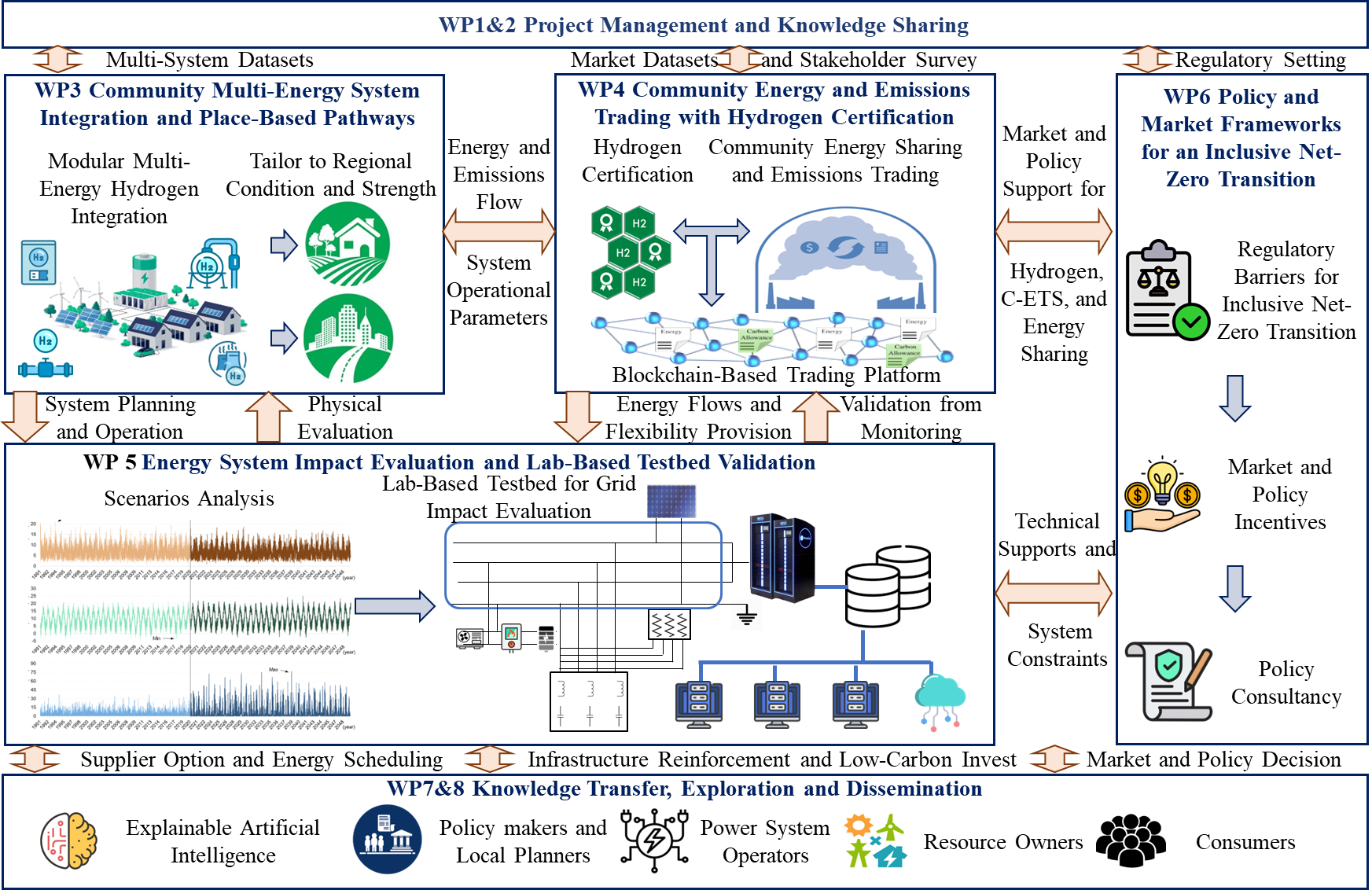
Multi-energy modelling
Develop whole-system models that integrate hydrogen flows, storage, and
conversion with community electricity, heating, transport, and socio-economic
conditions. The modelling framework combines local demand, weather, network,
technology-uptake, and community data with optimisation, power-flow analysis,
and thermal modelling, so local net-zero pathways can be tested against
infrastructure constraints, uncertainty, flexibility needs, investment decisions,
and place-based transition scenarios.
02
Community markets
Design hydrogen-integrated community energy sharing and emissions trading
mechanisms that connect households, prosumers, local businesses, authorities,
grid operators, and hydrogen assets. The market method co-simulates community
energy dynamics with policy incentives, carbon pricing, settlement rules,
hydrogen certification, and fairness indicators, so participation, lower costs,
emissions reduction, and investment signals can be assessed across different
stakeholder groups.
03
Testbed validation
Validate operational feasibility for future zero-inertia, 100% renewable
systems by linking operating scenarios with physical devices, RTDS platforms,
and AI control methods. Laboratory work examines electrolysers, storage, fuel
cells, heat pumps, power electronics, controllers, and monitoring dashboards,
producing evidence for ancillary services, flexibility, performance validation,
controller tuning, model calibration, safe operation, and deployment readiness.
04
Inclusive policy and XAI
Build transparent decision support that turns modelling results, socio-economic
indicators, affordability evidence, carbon and resilience metrics, and stakeholder
priorities into policy-relevant recommendations. Explainable AI methods such as
LIME and SHAP, visual dashboards, stakeholder workshops, and Community Advisory
Panels help policymakers, operators, and citizens understand model logic, compare
policy scenarios, identify community vulnerability, and support trusted, inclusive
participation in local net-zero transitions.
Work plan
Eight work packages across 48 months
WP1
Project Management and Knowledge Sharing
M1-M48, led by UoB
WP2
Preliminary Research
M1-M5, led by UoB
WP3
Community Multi-Energy System Integration
M6-M24, led by UNIPD
WP4
Community Energy and Emissions Trading
M6-M32, led by CU
WP5
Impact Evaluation and Lab-Based Validation
M18-M40, led by UDUR
WP6
Inclusive Policy and Market Frameworks
M33-M48, led by T4S
WP7
Knowledge Transfer and Capacity Building
M1-M48, led by UoB
WP8
Exploitation and Dissemination
M1-M48, led by UoB
Click a partner marker on the map to jump to its COHERENT profile.
Consortium
A cross-sector partnership in Europe and beyond
The consortium brings together universities, SMEs, technology partners, and
international associated partners across energy systems, hydrogen, AI, blockchain,
policy, social innovation, and community engagement.
Beneficiaries
Associated partners
Staff exchanges
Mobility as the engine of collaboration
COHERENT will fund 186 secondment months, supporting interdisciplinary training,
co-supervision, lab validation, community engagement, and durable collaboration
between academic and non-academic partners.
103months in period 1
83months in period 2
11funded beneficiaries
4global associated partners
People
Researchers by partner institution
Named researchers and project teams listed in the COHERENT proposal, grouped by
partner institution and disciplinary contribution.
Outputs
Deliverables, tools, workshops, and evidence
Public deliverables
Stakeholder framework and engagement strategies
Data inventory and analytical framework
Guidance for fair participation in C-ETS and energy sharing
Policy evidence on community energy, hydrogen, and inclusive net-zero
Digital and testbed results
Blockchain-based community energy trading prototype
Simulation platform for community energy systems
Lab testbed configuration and real-world performance report
XAI tools for informed decision-making
Engagement and capacity building
Two education and awareness campaigns
Two participatory workshops
Open-science data practices and knowledge-sharing events
COHERENT is pleased to announce a Call for Papers for the Special Session
Communications & AI for Smart Energy Communities at NextGCom 2026.
The conference will take place from 28-30 September 2026 in Kefalonia, Greece,
bringing together researchers and practitioners working on next-generation
communications, artificial intelligence, connected systems, and digital innovation.
The Special Session will place communications and AI research at the heart of the
net-zero transition. It welcomes original work that connects advanced digital
technologies with the operation, security, flexibility, and decarbonisation of smart
energy communities. Contributions may address theory, methods, system design,
experimental studies, prototypes, or real-world applications.
Topics of interest include:
6G and IoT connectivity for smart energy communities;
federated learning and distributed intelligence;
blockchain-enabled community energy trading;
smart-grid operation, coordination, and flexibility;
security, privacy, explainability, and trust; and
digital twins, platforms, and experimental testbeds.
Submissions will receive full peer review. Accepted and presented papers will be
published in the conference proceedings and submitted for inclusion in IEEE Xplore,
subject to the publisher's scope and quality requirements. The Special Session
provides an opportunity to connect communications research with COHERENT's work on
community energy sharing, AI-enabled decision support, secure digital platforms,
blockchain, and laboratory validation.
Important dates for this Special Session are:
Paper submission: 1 August 2026;
Notification: 14 August 2026; and
Camera-ready paper: 24 August 2026.
Researchers working across communications, energy systems, AI, cybersecurity,
blockchain, IoT, and sustainability are encouraged to submit and share the call with
their networks. The session is organised under the COHERENT project through the
Horizon Europe Marie Sklodowska-Curie Actions Staff Exchanges programme.
On 15 July 2026, a COHERENT-linked visit brought together University College Dublin
(UCD) and the University of Ruhuna (UoR) at the Faculty of Engineering in Galle, Sri
Lanka. The visit strengthened collaboration between two international COHERENT
partners and created an opportunity to connect researchers, students, and academic
teams working across communications, artificial intelligence, and sustainable
digital technologies.
The programme included discussions with students and researchers whose academic
journeys are closely connected to the visiting team, including Thulitha S. Chamara
Sandeepa, Charuka Moremada, Pramitha Fernando, Pasika Ranaweera, Madhusanka
Liyanage, and other colleagues. These exchanges highlighted the value of long-term
mentoring, international mobility, and research networks in developing expertise
across institutions and countries.
A research presentation introduced work from the Network Softwarization and
Security Labs (NetsLab) on trustworthy artificial intelligence for sixth-generation
mobile networks. The session considered how secure and explainable AI, network
softwarization, privacy-aware learning, and resilient communications can support the
emerging 6G ecosystem. Sri Lankan researchers have made important contributions to
this work, demonstrating the strength of the shared UCD-UoR research community.
For COHERENT, the visit supports the project's wider objectives for explainable AI,
secure digital platforms, interdisciplinary training, and international knowledge
exchange. It also creates links between communications research and COHERENT's
energy-system challenges, where trusted data, transparent decision support, and
reliable digital infrastructure are essential for community energy management,
low-carbon transitions, and inclusive participation.
The activity reflects the purpose of the Marie Sklodowska-Curie Actions Staff
Exchanges programme: enabling researchers to expand international networks, share
methods and experience, and create opportunities for talented researchers to
contribute to emerging interdisciplinary fields. COHERENT looks forward to building
on the visit through continued UCD-UoR collaboration, future exchanges, and joint
research across artificial intelligence, communications, energy, and sustainability.
UCD and UoR partners sharing research on trustworthy AI, 6G, and international
collaboration at the University of Ruhuna.
COHERENT partners from the University of Birmingham (UoB) and the University of
Zagreb Faculty of Electrical Engineering and Computing (UNIZG FER) strengthened
their collaboration during a project-linked visit to Zagreb in June 2026. The visit
brought the project's whole-system energy research into direct conversation with
researchers, businesses, public institutions, and policy stakeholders from Croatia
and the United Kingdom.
Representing UoB and the Birmingham Energy Institute, Dr Weiqi Hua contributed to
Green Energy Expo Zagreb, held on 9-10 June 2026. He presented perspectives on
whole-system energy modelling and digital innovation for a reliable and affordable
net-zero transition, and joined the panel on Data Centers and the Energy System.
Discussions explored the rapid growth of electricity demand from digital
infrastructure, the integration of renewable generation, system flexibility,
multi-energy coordination, hydrogen, and the investment and policy conditions
required for secure low-carbon development.
For COHERENT, the event provided an early opportunity to connect the project's
technical programme with real implementation challenges. The exchanges highlighted
how digitalisation, explainable decision support, community energy mechanisms, and
place-based net-zero pathways can help energy systems accommodate new demand while
remaining resilient, affordable, and inclusive.
During the visit, Dr Hua also met Prof Ninoslav Holjevac and colleagues at UNIZG FER.
The partners discussed joint work on community hydrogen, emissions trading,
renewable energy integration, multi-energy system modelling, and inclusive
transition pathways. This meeting helped translate the COHERENT kick-off priorities
into concrete collaboration between UoB and UNIZG, including research exchange,
shared methods, and future staff secondments.
The visit was supported by the strong UK-Croatia innovation network surrounding the
Green Energy Expo and the British Embassy Zagreb. COHERENT thanks the event
organisers, participating institutions, and all colleagues from industry,
government, and academia who contributed to the discussions. The project looks
forward to building on these connections as its four-year international programme
develops.
Panel discussion at Green Energy Expo Zagreb.Presenting COHERENT-related whole-system energy perspectives.Connecting with energy stakeholders from the UK and Croatia.Panel 6: Data Centers and the Energy System.Whole-system modelling for a reliable and affordable net-zero transition.UoB-UNIZG collaboration meeting at UNIZG FER.
We are pleased to announce the launch of COHERENT. On 9 June 2026, the COHERENT
consortium came together for the project kick-off meeting. The meeting marked the
start of a 4-year international collaboration across 15 organisations from the UK,
Europe, and global partner institutions.
The meeting established a common understanding of the project's objectives,
governance, work-package responsibilities, reporting arrangements, data management,
risk controls, communication processes, and practical planning for staff exchanges.
Academic and non-academic partners reviewed how their complementary expertise will
be connected across modelling, market design, experimental validation, policy, and
stakeholder engagement.
COHERENT will support an inclusive net-zero transition through an integrated research
programme covering:
multi-vector energy system modelling and place-based transition pathways;
community energy sharing, emissions trading, and hydrogen certification;
carbon reduction, affordability, resilience, and distributional assessment;
hardware-in-the-loop and laboratory validation of energy technologies and controls;
policy, legal, regulatory, and market frameworks for inclusive implementation; and
explainable AI and stakeholder-focused decision-support tools.
Partners also discussed the interfaces between the technical work packages. The
whole-system models will provide scenarios and evidence for community market design;
laboratory and real-time digital simulation will test operational feasibility; and
socio-economic, policy, and stakeholder research will ensure that proposed solutions
are transparent, trusted, and responsive to local needs.
Across the project, partners will carry out 186 person-months of staff exchanges.
The kick-off meeting began the detailed planning of these secondments, including host
capabilities, training objectives, knowledge-transfer activities, expected outputs,
and the support required for researchers moving between academic and non-academic
organisations. These exchanges will strengthen collaboration, share technical
expertise, and build lasting research and innovation capacity across the consortium.
Immediate next steps include confirming the first exchange schedule, establishing
project-wide data and communication procedures, refining shared case studies, and
coordinating the initial modelling, market, validation, and stakeholder tasks. The
consortium will use regular technical meetings and cross-work-package reviews to keep
the research aligned and to identify opportunities for joint publications,
demonstrations, training, and dissemination.
We thank all consortium partners, the project officer, and the research support teams
for their contributions to a productive and well-structured kick-off meeting. We look
forward to working together over the next four years to advance inclusive,
low-carbon, and community-centred energy transitions.
COHERENT consortium partners at the online project kick-off meeting.
COHERENT officially started in June 2026, launching a four-year Horizon Europe Marie
Sklodowska-Curie Staff Exchanges collaboration across universities, research teams,
SMEs, and international partner institutions. The project brings together expertise
in energy systems, hydrogen, emissions trading, digital technologies, experimental
validation, policy, and community engagement.
Through coordinated research and 186 person-months of staff exchanges, partners will
develop and test methods that connect whole-system modelling with community energy
markets, hydrogen certification, carbon assessment, explainable AI, and inclusive
policy design. Exchanges between academic and non-academic organisations will enable
researchers to share facilities, data, methods, and practical implementation
experience.
The programme is designed to produce both scientific advances and durable research
capacity. COHERENT will support joint publications, open and reusable research
outputs, training, stakeholder dialogue, and international collaboration, while
keeping affordability, fairness, resilience, and community participation central to
the transition to net zero.
COHERENT welcomes engagement from energy communities, local authorities,
regulators, technology providers, SMEs, system operators, and civil-society
organisations interested in inclusive hydrogen-enabled energy transitions.
Dr Weiqi HuaThe University of BirminghamBirmingham, United KingdomE: w.hua@bham.ac.uk